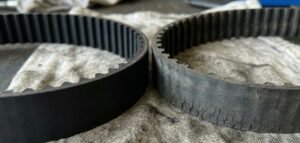
The Timing Belt is different. It is the “silent killer” of engines. In most cases, a timing belt sounds and feels perfectly normal right up until the millisecond it snaps. When it does, your engine simply shuts off—often permanently.
At MGI Auto, we hate delivering bad news. There is nothing worse than telling a customer that their perfectly good car is now scrap metal because a rubber belt failed. Here is what you need to know to prevent that from happening.
What Does a Timing Belt Do?
Think of your engine as a finely choreographed dance. Inside the engine, there are Pistons moving up and down, and Valves opening and closing to let air in and exhaust out. They occupy the exact same space, just at different times.
The Timing Belt is the conductor of this orchestra. It connects the crankshaft (pistons) to the camshaft (valves), ensuring they move in perfect sync.
The “Interference” Danger
Why is a snapped belt so catastrophic? Most modern vehicles (Hondas, Toyotas, VWs, Subarus) have what is called an “Interference Engine.”
This means that if the timing belt snaps, the pistons keep moving upward due to momentum, but the valves stop moving immediately. The Result: The pistons smash into the open valves at thousands of RPM. Valves bend, pistons crack, and cylinder heads are destroyed. In plain English: Your engine effectively destroys itself from the inside.
5 Signs You Are Living on Borrowed Time
While the belt often snaps without warning, there are sometimes subtle clues.
1. The Mileage Number (The Only Real Indicator)
This is the most important factor. You cannot “inspect” a timing belt visually to see how much life is left. Internal cords can be weak even if the rubber looks fine. Check your owner’s manual. Most manufacturers recommend replacement between 100,000 km and 160,000 km, or every 7 years. If you bought a used car and don’t have a record of it being changed, assume it hasn’t been done.
2. A Ticking Noise from the Engine Bay
If you hear a fast-paced ticking or clicking sound coming from the front of the engine (not the top), it could be a worn belt slapping against the plastic timing cover, or a failing tensioner pulley.
3. Oil Leaks at the Front of the Motor
Oil destroys rubber. If your front crankshaft seal or camshaft seal is leaking, hot oil will soak into the timing belt. This causes the rubber to degrade and peel apart rapidly. If you see oil dripping near the front pulleys, your belt is at risk.
4. Rough Idling or Misfires
Sometimes, a belt doesn’t snap; it “jumps a tooth.” If the belt has stretched due to age, it might slip just one notch. This throws off the engine timing, causing the car to run roughly, shake, or trigger a Check Engine Light.
5. Difficulty Starting in the Cold
In Calgary, old rubber gets brittle. If your belt is glazed and hard, the extreme tension of a -30°C cold start can be the final straw that causes it to strip or snap.
Why Do Mechanics Suggest the Water Pump Too?
You bring your car in for a timing belt quote, and we recommend replacing the Water Pump at the same time. Are we just trying to upsell you?
Absolutely not. In 90% of vehicles, the water pump is driven by the timing belt and is buried deep behind it. To get to the water pump later, you would have to pay the exact same 4-6 hours of labor all over again. Since the pump is relatively cheap ($100-$150), it makes zero financial sense to put an old water pump back in with a new belt. We do it together to save you money in the long run.
The Cost of Waiting
We know a timing belt service isn’t cheap. It is a labor-intensive job that requires precision and special tools. However, compare the math:
- Preventative Timing Belt Service: Approx. $800 – $1,400 (depending on the car).
- Used Engine Replacement (after failure): $4,000 – $7,000.
Conclusion: Don’t Gamble with Physics
If you are unsure about the status of your timing belt, don’t guess. Bring your vehicle to MGI Auto. While we can’t see inside the belt cords, we can check for external cracking, oil contamination, and verify your manufacturer’s recommended interval.
Driving on an overdue timing belt is like pulling the pin on a grenade and holding it. It’s not a matter of if it will go off, but when.