Heads turn. Pedestrians look at you. You instinctively sink lower in your seat, hoping nobody noticed that the ear-piercing noise came from your car.
Brake noise is more than just embarrassing; it is your vehicle’s way of communicating with you. Unlike an engine problem which might be hidden, brakes usually give you plenty of audible warnings before they fail. The problem is that many drivers turn up the radio and ignore them until it’s too late.
In this post, MGI Auto decodes the sounds and sensations of a failing brake system, and explains why brake service in Calgary requires a different approach than in warmer climates.
1. The High-Pitched Squeal (The Early Warning)
If you hear a high-pitched squeak or whistle while braking, but the car stops fine, don’t panic. This is usually a design feature, not a bug.
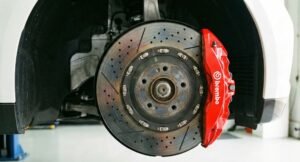
Most modern brake pads are equipped with a small metal tab called a Wear Indicator. When the friction material on your pads wears down to the safety limit (usually 2-3mm), this metal tab touches the rotor, creating that annoying squeal.
The Verdict: Your car is telling you, “Book an appointment soon.” You have a bit of time, but your pads are near the end of their life.
2. The Metal-on-Metal Grind (The “Too Late” Stage)
If that squeal turns into a loud, guttural growl or grinding sound that you can feel in the pedal, you have crossed the line into dangerous territory.
This sound means the brake pad material is completely gone. You are now pressing bare metal backing plates against the metal brake rotor.
- The Cost: Every time you hit the brakes now, you are destroying your rotors. What could have been a simple $300 pad replacement is now likely a $600+ job because the rotors are unfixable.
- The Safety Risk: Metal-on-metal provides almost no friction. Your stopping distance will increase dramatically.
3. The Steering Wheel Shake (The “Warped” Myth)
Do you feel the steering wheel vibrate in your hands when you brake from highway speeds? Many people (and even some mechanics) call this “warped rotors.” While rotors can warp from extreme heat (like driving down a mountain with your foot on the brake), the cause is often different.
In Calgary, this is frequently caused by Uneven Pad Deposition or Rust Jacking. If a car sits parked after a wet or snowy drive, the pads can rust onto the rotors. This leaves a high spot on the metal. Every time the wheel spins, the pads hit that high spot, sending a vibration up through the steering column.
4. The Calgary Factor: Why “Pad Slaps” Don’t Work Here
This is the most critical point for Alberta drivers. A “Pad Slap” is when a mechanic simply takes off the old pads and slaps on new ones without servicing the rest of the system.
In Arizona or California, you might get away with this. In Calgary, you cannot.
Our roads are covered in salt, brine, and gravel for six months of the year. This corrosive sludge attacks your Caliper Slide Pins—the metal pins that allow your brakes to float freely. If these pins seize up (rust in place):
- Uneven Wear: One pad will do all the work while the other does nothing.
- Dragging Brakes: The caliper won’t release after you let go of the pedal, burning up your new pads and ruining your fuel economy.
The MGI Standard: At MGI Auto, we don’t just change pads. We perform a full Brake Caliper Service. We remove the slide pins, clean off the old corrosion, and lubricate them with high-temperature silicone grease. This ensures your brakes engage evenly and release fully, every single time.
5. The Sponge Factor (Brake Fluid)
When was the last time you changed your brake fluid? Brake fluid is “hygroscopic,” meaning it absorbs moisture from the air. Over time, that moisture lowers the boiling point of the fluid.
If you have to panic-brake on Deerfoot Trail, the heat generated can cause that water-logged fluid to boil. When fluid boils, it turns to gas. Gas compresses. The result? You step on the pedal, and it goes straight to the floor without stopping the car.
We test your brake fluid for moisture content during our inspections to ensure your hydraulic system is solid.
Conclusion: Stop Guessing
Your brakes are the single most important safety system on your vehicle. It doesn’t matter how fast your car can go if it can’t stop when a deer jumps onto the road.
If you are hearing squeaks, feeling shakes, or if your brake pedal feels “mushy,” don’t wait.
At MGI Auto, we use premium ceramic brake pads that offer low dust and quiet operation, and we treat every brake job with the Calgary winter in mind.